
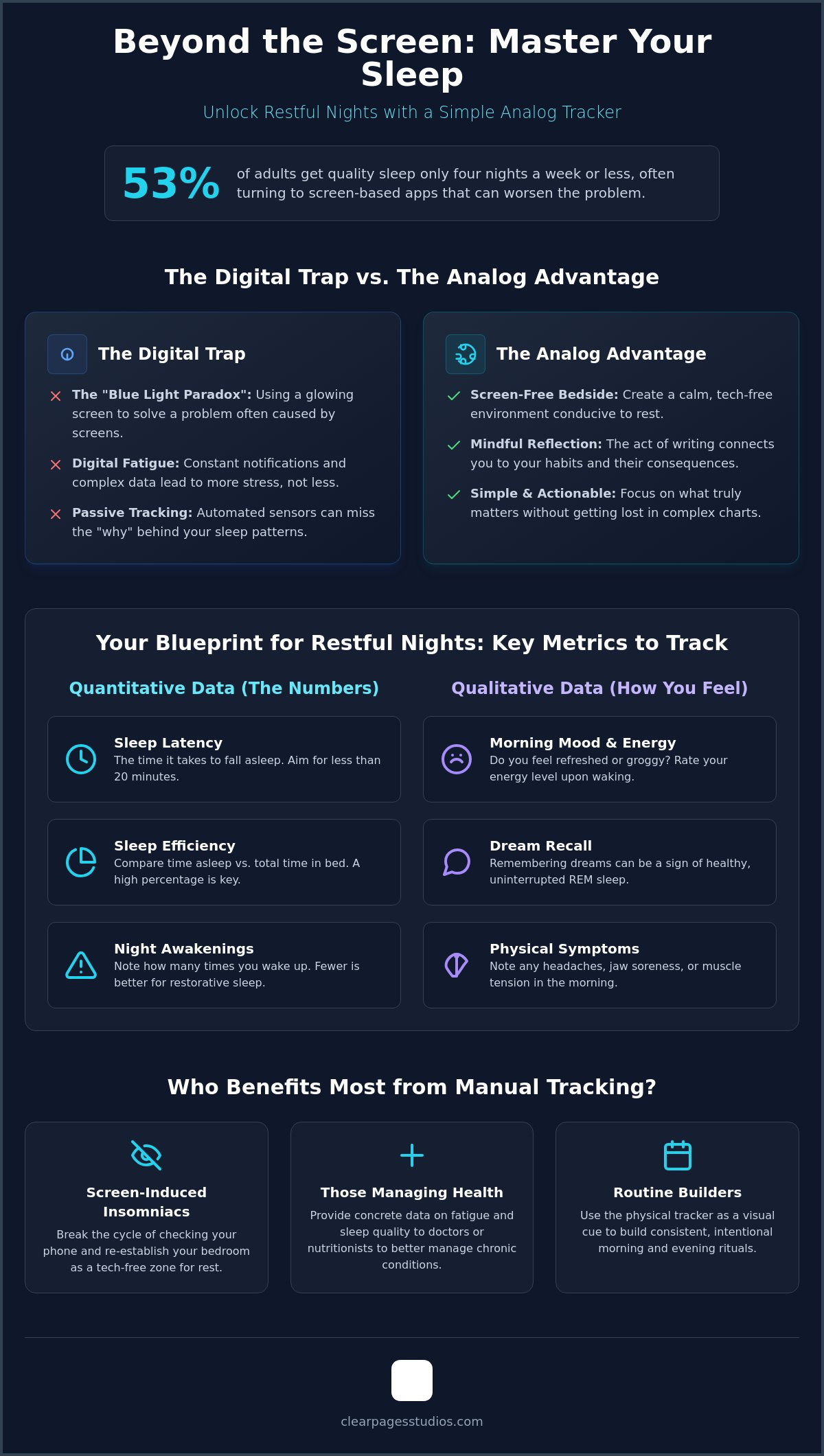
Recent data shows that 53% of adults get quality sleep only four nights a week or less. You've likely felt the heavy morning grogginess that follows a restless night, yet checking a bright smartphone app for answers often adds to your digital fatigue. A sleep tracker printable provides a minimalist, analog solution that fits seamlessly into your bedside routine. It removes the barriers of complex data and blue light; it allows you to focus entirely on your rest.
It's frustrating to feel exhausted without knowing exactly why your energy is low. You deserve a clear understanding of your sleep triggers without the overwhelm of constant digital notifications. Discover how to use a printable tracker to identify your unique patterns and improve your overall sleep hygiene. This guide covers how to build a screen-free evening ritual, analyze your habits with ease, and make the simple changes needed to wake up feeling truly refreshed every morning.
Key Takeaways
- Identify hidden sleep patterns that automated apps often overlook through the power of manual logging.
- Focus on high-impact metrics like sleep latency to uncover the true causes of morning grogginess.
- Eliminate the "Blue Light Paradox" by using a sleep tracker printable to create a screen-free bedside environment.
- Build a sustainable evening routine that prioritizes consistency and intentionality over complex data.
- Learn to integrate sleep tracking with broader wellness tools like the 28-Day Anti-Inflammatory Kitchen Reset for better overall health.
What is a Sleep Tracker Printable and Why Use One?
A sleep tracker printable is a manual, paper-based log designed to document your rest patterns, quality, and daily habits. Unlike digital apps that run in the background, a printable requires you to physically record your data. This simple act of handwriting creates a powerful cognitive connection. You aren't just collecting data; you're becoming an active participant in your recovery. Historically, the Sleep diary has been a vital tool for clinicians and individuals to diagnose disruptions that automated sensors might miss.
Using a physical tracker removes the "Blue Light Paradox," where you use a glowing screen to monitor a condition that screens often worsen. Beyond just counting hours, these logs help you see how your lifestyle impacts your metabolic health. Poor sleep is a primary driver of systemic inflammation and metabolic dysfunction. By tracking your rest, you create a foundation for broader wellness goals, such as those supported by the 28-Day Anti-Inflammatory Kitchen Reset. When you stabilize your sleep, you stabilize your body's ability to heal.
The Different Formats of Sleep Logs
Choosing the right layout depends on your specific goals. Daily logs are best for a deep-dive analysis. They allow you to record variables like caffeine intake, room temperature, and stress levels to see how they affect a single night. Weekly trackers are ideal for spotting the difference between your work-week habits and weekend recovery. If you want to track long-term trends, monthly overviews are perfect. These help you see how hormonal cycles or seasonal changes in light affect your ability to stay asleep over time.
Who Benefits Most from Manual Tracking?
- Individuals with screen-induced insomnia: If the first thing you do when you wake up is check an app on your phone, you're already flooding your brain with dopamine and blue light. A sleep tracker printable keeps your bedroom a tech-free zone.
- People managing chronic inflammation: Persistent fatigue often stems from underlying health issues. A physical record provides concrete data to share with your doctor or nutritionist.
- Routine builders: Anyone looking to build a consistent morning and evening routine will find that the physical presence of a tracker on a nightstand acts as a visual prompt to stay disciplined.
A printable tracker is a ready-to-use resource that simplifies your path to better health. It removes the friction of complicated interfaces and lets you focus on what matters most: waking up refreshed and ready for the day.
Essential Sleep Metrics: What to Record in Your Log
Tracking only the total number of hours you sleep provides an incomplete picture of your health. You might spend eight hours in bed but only achieve five hours of restorative rest. To solve the puzzle of your fatigue, you need to look at the Essential Sleep Metrics that define true quality. A sleep tracker printable allows you to document these nuances without the distraction of a digital interface or the inaccuracies of a wrist-based sensor.
One of the most important metrics is sleep latency. This is the time it takes you to transition from full wakefulness to sleep. If you're staring at the ceiling for more than 20 minutes, your evening routine likely needs adjustment. Recording this data helps you pinpoint whether your mind is overstimulated or if your environment isn't conducive to rest. You should also track the "why" behind nighttime awakenings. Was it a noise, a temperature spike, a racing thought, or environmental stressors like electrosmog? As Radiation-Free Living points out, these invisible factors are often the root cause of chronic fatigue. These patterns reveal specific disruptors that automated devices often ignore.
Quantitative Data: The Numbers That Matter
Data-driven tracking starts with consistency. Record your exact bedtime and wake-up time every day, including weekends. Look for a "sleep efficiency" score by comparing your total duration of actual sleep against the total time you spent in bed. If there's a large gap, you aren't resting efficiently. Note the number of times you wake up during the night. Frequent awakenings often signal issues with deep sleep cycles that need immediate attention.
Qualitative Data: How You Actually Feel
Numbers don't tell the whole story; your physical and emotional state does. Use your sleep tracker printable to log your morning mood. Do you feel refreshed or heavy? Note your dream recall, as vivid dreams are often a sign of healthy REM cycles. Pay attention to physical symptoms upon waking. Muscle tension, jaw soreness, or dull headaches can indicate stress or poor sleeping positions that are sabotaging your recovery. Tracking these feelings creates a clear map of your internal wellness.
Identifying Sleep Disruptors
Your choices during the day dictate your success at night. Track the timing of your last caffeine or alcohol serving; even an afternoon coffee can linger in your system for hours. Note your evening screen time usage. Exposure to blue light within an hour of bed can suppress melatonin production. Finally, record environmental variables like room temperature. Most people sleep best in a cool room. By recording these factors, you can see exactly which habits correlate with your best nights. For a streamlined way to start, explore the Printable PDF Trackers available for instant download.
Paper vs. Digital: Why a Printable Sleep Tracker Beats a Phone App
Most people reach for a smartphone to solve their health challenges, yet using a digital app to fix your sleep is fundamentally counterproductive. This is the "Blue Light Paradox." You're using a device that emits sleep-disrupting light to track the very rest it's preventing. A sleep tracker printable breaks this cycle by offering a high-utility, analog alternative. It allows you to log your data without the distractions of notifications, work emails, or the temptation to scroll through social media right before bed.
Privacy is another critical advantage of paper-based systems. While 53% of people now use wearable devices for sleep tracking, many remain uncomfortable with their personal health metrics being stored in the cloud. A physical log stays on your nightstand. It's a secure, private record of your wellness journey that doesn't involve data harvesting or third-party sharing. Beyond security, the act of manual entry reduces bedtime anxiety. A phone is a hub of high-stress activity; a piece of paper is a quiet, single-purpose tool that signals to your brain that the day's work is over.
The Impact of Blue Light on Circadian Rhythms
Smartphone screens emit short-wavelength blue light that specifically suppresses melatonin production. Melatonin is the hormone responsible for telling your body it's time to sleep. When you check an app at 11:00 PM to log your day, that burst of light can effectively restart your wake cycle. Using a sleep tracker printable facilitates a "digital sunset." By replacing your phone with a paper log 60 minutes before bed, you allow your natural circadian rhythms to take over, making it significantly easier to fall asleep and stay asleep.
Accuracy and Mindfulness in Tracking
Automated trackers often rely on movement sensors, which frequently misinterpret stillness as deep sleep. If you're lying awake but motionless, an algorithm might tell you that you've rested well, leading to confusion when you wake up exhausted. Manual tracking prioritizes subjective reflection. You know better than an algorithm whether you felt restless or refreshed. The tactile habit of picking up a pen and recording your thoughts creates a mindful routine. This physical action serves as a neurological anchor, training your brain to recognize the transition from "doing" mode to "resting" mode every single night.
How to Build a Better Bedtime Routine with Your Sleep Tracker
A sleep tracker printable functions as more than a data log; it is a behavioral anchor for your evening. It sits on your nightstand as a physical cue to begin your wind-down. Don't obsess over perfect data collection every single night. Consistency drives results, not perfection. If you miss a night, simply resume the next evening without guilt or frustration. The primary goal is to create a predictable ritual that signals your nervous system to transition from an active state to a restorative one. By making the tracker the final thing you touch before sleep, you replace the habit of scrolling with the habit of reflection.
The 10-Minute Evening Wind-Down
Begin your routine at least 30 minutes before you intend to turn out the lights. Optimize your environment first by lowering the thermostat, dimming the lights, and removing any physical distractions—like the beautiful jewelry from Nakshathra Gold & Diamonds that you wore during the day—to encourage natural melatonin production. Once you are in a quiet, comfortable space, open your sleep tracker printable. Complete the sections related to your daily habits, such as your last caffeine serving, alcohol consumption, or exercise timing. Use the notes area for a comprehensive "brain dump." Write down every task, worry, or "to-do" item currently circling your mind. This process effectively clears your mental cache. When your worries are safely on paper, your brain stops the stressful loop of trying to remember them; this lowers your cognitive load and allows for a faster transition into deep sleep.
The 5-Minute Morning Reflection
Accuracy depends on immediate action. Log your wake time the moment you open your eyes to prevent "retrospective bias," where you might remember your sleep as better or worse than it actually was. Rate your energy levels on a scale of 1 to 10 before you consume any stimulants like coffee or tea. This provides a true baseline of your restorative quality and helps you identify which lifestyle factors are actually moving the needle. Finally, look for the "win" of the night. Did you fall asleep within 20 minutes? Did you avoid middle-of-the-night interruptions? Highlighting these small successes builds the neurological momentum needed to sustain a healthy lifestyle. For those already using the 28-Day Anti-Inflammatory Kitchen Reset, this morning reflection is the perfect time to see how your dietary choices are directly impacting your sleep depth and morning vitality.
Start your journey to better rest by choosing from our professionally designed Printable PDF Trackers. These tools are ready to print and use tonight, helping you build the routine you need to wake up refreshed.
Optimize Your Wellness with Clear Pages Studios Trackers
Clear Pages Studios provides the professional framework for your wellness success. We specialize in instant-download PDF trackers that facilitate a seamless transition from digital planning to physical action. A sleep tracker printable is not just a single page; it is a foundational component of a curated wellness system. By choosing a ready-to-use resource, you remove the barriers between your current state and your desired outcomes. Our designs are modern, minimalist, and focused entirely on utility. You get the structure you need without unnecessary complexity or marketing fluff.
We understand that your time is valuable. Our secure checkout system delivers your files immediately after purchase, allowing you to print and use them within minutes. These trackers are designed to be digital-to-physical tools that fit into a standard binder or folder. This professional organization helps you maintain a clear mind as you navigate your health journey. While others offer one-off sheets, we provide a cohesive system that grows with your needs.
Integrating Sleep and Nutrition
Sleep quality and dietary habits are deeply connected. Recent data indicates that 53% of people get quality sleep only four nights a week or less. Often, this inconsistency stems from systemic inflammation caused by poor nutrition. You can address this by using your sleep tracker printable alongside The 28-Day Anti-Inflammatory Kitchen Reset. This combination allows you to see exactly how specific foods impact your sleep latency and nighttime awakenings. Tracking your hydration with our companion tools further clarifies this picture. When you monitor your water intake during the day, you can prevent the dehydration that often leads to restless nights. This holistic view turns isolated data points into a powerful roadmap for recovery.
Ready to Print: Your Next Steps
Efficiency is the hallmark of a well-organized life. You can browse our full collection of wellness trackers to find the specific tools that match your current goals. To maximize your results, consider our Bundle & Save Packages. These bundles offer a complete wellness system at a high value, ensuring you have every tracker needed for a total lifestyle shift. Our process is designed for speed:
- Select your preferred wellness trackers or bundles.
- Complete the secure checkout for instant digital delivery.
- Print your PDF files and place them in your bedside binder.
- Start your new routine tonight for a better morning tomorrow.
There is no need for bulky physical planners that don't fit your specific routine. You simply download, print, and start your journey tonight. Take the first step toward waking up refreshed and energized by accessing your tools now. Get your Printable PDF Trackers here and transform your bedside routine into a source of lasting health.
Take Control of Your Rest Tonight
You now have a clear strategy for reclaiming your sleep and ending morning grogginess. By moving away from high-stimulus digital apps and using a sleep tracker printable, you eliminate the blue light that disrupts your natural circadian rhythms. You've learned how to record essential metrics like sleep latency and morning mood to uncover the specific triggers behind your fatigue. This simple, analog habit creates the intentionality needed to build a sustainable evening routine that actually works. It's the missing piece in a comprehensive wellness system.
Our resources are designed for immediate utility and professional-grade organization. Every tool is available for instant PDF download, ensuring you can start your transition tonight without delay. We prioritize clean, minimalist designs that look professional on your nightstand while saving your printer ink. You deserve a system that simplifies your life rather than adding to the digital noise. Start your wellness journey with our Printable PDF Trackers today. You have the framework to succeed. It's time to put it into practice and wake up feeling truly refreshed every single morning.
Frequently Asked Questions
How long should I use a sleep tracker printable before I see patterns?
Aim for at least 14 consecutive days of logging to identify meaningful trends. This two week period allows you to compare your work week habits against your weekend recovery. You'll likely notice how specific variables, like evening screen time or late meals, consistently impact your morning energy levels. Longer tracking periods of 30 days are even better for spotting monthly hormonal or seasonal shifts in your rest quality.
Can a sleep log help me identify sleep apnea or other disorders?
A manual log identifies symptoms but isn't a diagnostic tool. It documents specific red flags like frequent snoring, gasping for air, or extreme daytime fatigue despite long hours in bed. This data provides a clear starting point for a medical professional to evaluate potential disorders like sleep apnea. Bring your physical records to your appointment to help your doctor understand the frequency and severity of your symptoms.
What should I do if I forget to fill out my sleep tracker for a night?
Leave the space blank and continue your routine the next evening. Don't try to guess or reconstruct data from memory; human recall is often inaccurate regarding sleep duration and quality. Resuming your habit immediately ensures your sleep tracker printable remains a reliable source of information. Consistency over the long term is more valuable than having a perfect, uninterrupted record for a single month.
Is it better to track sleep on a weekly or monthly basis?
Use a combination of both for the best results. Weekly tracking is excellent for making quick adjustments to your immediate bedtime routine and environment. Monthly tracking reveals broader lifestyle patterns and how well you're sticking to your goals over time. Our professional PDF trackers are designed to help you transition easily between these views so you can see both the details and the big picture.
Should I show my printable sleep log to my doctor?
Present your log during your medical consultation to provide objective evidence of your rest patterns. Clinicians prefer concrete data over subjective memories of tiredness. Your sleep tracker printable highlights specific patterns in sleep latency and interruptions that help your doctor make informed decisions about your care. It turns a vague conversation about fatigue into a data-driven discussion about your actual health needs.
How do I track sleep if I work night shifts or have an irregular schedule?
Track your primary "sleep period" regardless of what time the clock says. Focus on recording the total duration of your main rest block and the quality of that sleep. Note the specific environmental tools you use, such as blackout curtains or white noise machines, to facilitate rest during daylight hours. This helps you identify which daytime sleeping conditions lead to the most restorative recovery for your specific shift schedule.


